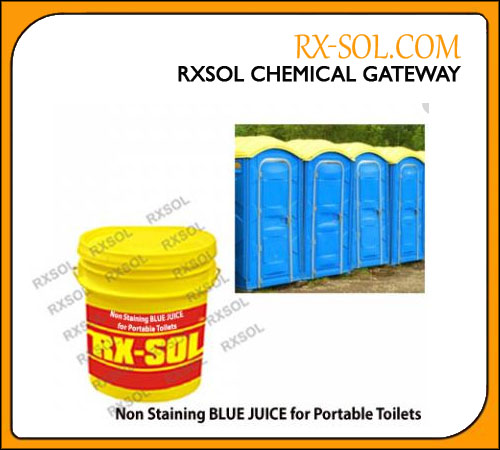
Non Staining BLUE JUICE for Portable Toilets
Part No: RXSOL-15-1025-020
SodiumChlorite is also used for water treatment purpose.
Sodium Chlorite is being mainly supplied to textile industry, water purification Industry, etc. SODIUM CHLORITE pure is a white crystalline solid. Difficult to burn, but accelerates the burning of organic substances. Used in water purification, to bleach wood pulp, textile, fats, oils; and for many other uses.
Application
NaClO2 or ClNaO2 have 2 No of Hydrogen Bond Acceptor capacity. Most Commonly Used in water purification, to bleach wood pulp, textile, fats, oils; and for many other uses.
Dosage
Sodium chlorite is a powerful oxidizer which makes make it a useful pesticide and herbicide. Sodium chlorite plays a very important role to deactivate many types of poisons by interacting with them and changing their chemical composition due to its powerful oxidizing powers.
Technical Specification
MSDS

| Product Name | : Sodium Chlorite Solution 7.5% |
| Part Number | : RXSOL-42-1977-030 |
Company Details:
RX MARINE INTERNATIONAL
105, A wing , BSEL , TECH PARK.
VASHI ,NEW BOMBAY 400703 INDIA
Branch : Kandla, Mumbai , Chennai, Vizag, Kolkata, UAE , OMAN and CANADA
| Phone | +91 22 20871200 - 1400 |
| Fax | +91 22 2761 2100 :::AOH :0091 9821214367 |
| 123@rxmarine.com | |
| Website | www.rxmarine.com |

| Name of Substance | Cas Number | Wt.% | Symbol |
| Sodium Chlorite | 7758-19-2 | 7.5.00 % | Xi |
| Sodium Hydroxide | 1310-73-2 | 0.5-1.0 % | C |
| Sodium Carbonate | 497-19-8 | 0.5-1.0 % | Xn |
| Non Hazardous Compound | Proprietory | 60 - 70% | --- |

| Signal Word | Danger |
| Hazard Statements |
H302 Harmful if swallowed. |
| Precautionary statements - prevention |
P260 Do not breathe vapour/spray. |
| Precautionary statements - response |
P301+P310 IF SWALLOWED: Immediately call a POISON CENTER/doctor. P303+P361+P353 IF ON SKIN (or hair): Take off immediately all contaminated clothing. Rinse skin with water/shower. P305+P351+P338 IF IN EYES: Rinse cautiously with water for several minutes. Remove contact lenses, if present and easy to do. Continue rinsing. P391 Collect spillage. P405 Store locked up. P501 Dispose of contents/container in accordance with national regulations. |

| Eye Contact | Hold eye open and rinse slowly and gently with water for 15-20 minutes. Remove contact lenses, if present, after the first five minutes, then continue rinsing eye. Get immediate medical attention. |
| Skin Contact | Wash off immediately with soap and plenty of water while removing all contaminated clothes and shoes. Get medical attention if irritation persists. |
| Inhalation: | If inhaled, remove from area to fresh air. Get medical attention if respiratory irritation develops or if breathing becomes difficult. |
| Ingestion: | If swallowed, call a poison control center or doctor immediately. Do NOT induce vomiting. If conscious, drink plenty of water. |
| General Advice | Chlorine dioxide vapors are emitted when this product contacts acids or chlorine. If these vapors are inhaled, monitor patient closely for delayed development of pulmonary edema which may occur up to 48-72 hours post inhalation. See Section 11 for Toxicological Information |

| Flamibility / Flash point | Not Applicable |
| Suitable extinguishing media | Extinguish with carbon dioxide, dry chemical, foam or waterspray. |
| Protective Equipment | Use personal protective equipment. |
| Hazardous combustion products | Disodium oxide. Hydrogen chloride. Oxygen. Contact with acids, organic materials, reducing agents or chlorine donors will produce chlorine dioxide gas and heat. Ventilate area with large amounts of air to keep the chlorine dioxide concentration low. |
| Advice for firefighters | As in any fire, wear self-contained breathing apparatus and full protective gear. |
| Specific extinguishing methods | Approach fire from upwind to avoid hazardous vapors and toxic decomposition products. Use flooding quantities of water as fog or spray. This product becomes a fire or explosion hazard if allowed to dry, so use water spray to keep fire-exposed containers cool. Extinguish fire using agent suitable for surrounding fire. Firefighters should wear full protective clothing (chemically impermeable, full encapsulated suit) and positive pressure self-contained breathing apparatus. |

| Personal precautions, protective equipment and emergency procedures |
Immediately evacuate personnel to safe areas. Keep unnecessary personnel away. Keep people away from and upwind of spill/leak. Wear appropriate protective equipment and clothing during clean-up. Do not |
| Enviromental Precaution | Avoid release to the environment. Avoid discharge into drains, water courses or onto the ground. Contact local authorities in case of spillage to drain/aquatic environment. |
|
Methods and materials for containment and cleaning up |
Isolate spill area and deny entry to unnecessary or unprotected personnel. Remove all sources of ignition, such as flames, hot glowing surfaces or electric arcs. Stop source of spill as soon as possible and notify appropriate personnel. Cleanup personnel must wear proper protective equipment (refer to Section 8). Notify all downstream water users of possible contamination. |

| Advice on safe handling | Use only in a well-ventilated area. Wear chemically resistant protective equipment during handling. Do not breathe mist or vapor. Do not taste or swallow. Keep away from heat. Do not handle, store or open near an open flame, sources of heat or sources of ignition. Protect material from direct sunlight. Do not let the product dry. When using, do not eat, drink or smoke. Keep away from clothing and other combustible materials. Observe good industrial hygiene practices. Avoid release to the environment. |
| Storage | Store in a cool, dry place out of direct sunlight. Store in a well-ventilated place. Storage area should be clearly identified, clear of obstruction and accessible only to trained and authorized personnel. Store away from incompatible materials (see Section 10 of the SDS). Store in original tightly closed container. Do not store near combustible materials. Do not handle or store near an open flame, heat or other sources of ignition. |
| Advice on general occupational hygiene | Use good work and personal hygiene practices to avoid exposure. When using do not smoke, eat or drink. Wash hands before eating, drinking or smoking Remove contaminated clothing |

| Engineering Controls |
Good general ventilation (typically 10 air changes per hour) should be used. Ventilation rates should be matched to conditions. If applicable, use process enclosures, local exhaust ventilation, or other engineering controls to maintain airborne levels below recommended exposure limits. If exposure limits have not been established, maintain airborne levels to an acceptable level. Use separate, corrosion-resistant ventilation system to capture mist or fume. Do not use wood or other combustibles to construct vent system. Prevent entry into bearings or gear boxes, which could cause an explosion. Provide eyewash station. |
| Personal Protection |
Eye/face protection : Wear safety glasses with side shields (or goggles) and a face shield. Provide an emergency eye wash fountain and quick drench shower in the immediate work area. |
| Exposure Conrol |
All chemical Personal Protective Equipment (PPE) should be selected based on an assessment of both the chemical hazard present and the risk of exposure to those hazards. The PPE recommendations below are based on an assessment of the chemical hazards associated with this product. Where this product is used in a mixture with other products or fluids, additional hazards may be created and as such further assessment of risk may be required. The risk of exposure and need of respiratory protection will vary from workplace to workplace and should be assessed by the user in each situation. |
| Hygiene measures | Keep from contact with clothing and other combustible materials. Remove and wash contaminated clothing promptly. Upon completion of work, wash hands before eating, drinking, smoking or use of toilet facilities. When using do not smoke. Always observe good personal hygiene measures, such as washing after handling the material and before eating, drinking, and/or smoking. Routinely wash work clothing and protective equipment to remove contaminants. |


Gloves Suit

| Form | Liquid |
| Apperance | Clear, water white to slightly yellow |
| Odour | Faint bleach-like odour |
| Odor threshold | Not applicable |
| Flash Point | Not Determine |
| Boiling Point | 106 °C (1013 hPa) |
| Freezing Point | 3°C (37.4°F) |
| pH | 11-13 |
| Evaporation rate | No information available |
| Flammability (solid, gas) | No data available |
| Upper explosion limit | No data available |
| Lower explosion limit | No data available |
| Explosive properties | No data available |
| Vapor pressure | 19.87 hPa (20℃) |
| Vapor density | No information available |
| Specific gravity | 1.01 - 1.04 @ 20`C |
| Relative density | Not Availabe |
| Water solubility | Miscible in water |
| Solubility in other solvents | No data available |
| Partition coefficient: octanol | No data available |
| Autoignition temperature | No data available |
| Thermal decomposition | No data available |
| Viscosity, kinematic | No data available |
| Explosive properties | No data available |
| Oxidizing properties | No data available |
| Dynamic viscosity | No data available |
| Formula | NaClO2 |
| Molecular Weight | 90.45 |

| Recativity | Not reactive under normal temperatures and pressures |
| Stability | Stable in itself, but reactive as detailed below. |
| Possibility of hazardous reactions | Avoid heat, flames, sparks and other sources of ignition. Avoid evaporation to dryness. Dried material can ignite uponcontact with combustibles. Avoid contamination with foreign materials. Avoid exposure to sunlight or ultraviolet light. |
| Incompatible materials | acids. reducing agents. combustible material. oxidizing agents. hypochlorite. organic solvents and compounds.garbage. dirt. organic materials. household products. chemicals. soap products. paint products. vinegar, beverages,oils, pine oil, dirty rags, sulfur-containing rubber, or any other foreign matter. |
| Hazardous Decomposition |
Chlorine dioxide is formed on contact with acids, Thermal decompositionproducts include chlorine and oxides of sodium |
| Condition to Avoid | Keep away from heat, sparks and open flame. Keep away from direct sunlight and contact with incompatible materials. This product may react with reducing agents. |
| Polymerization | Hazardous polymerization does not occur. |

|
Acute toxicity |
INHALATION Inhalation may cause irritation of the mucous membranes and respiratory tract. Symptoms may include coughing, bloody nose, and sneezing. Severe overexposures may cause lung damage. ANIMAL TOXICOLOGY Inhalation LC50: No available data Dermal LD50: > 2 g/kg (rabbit) Oral LD50: 165 mg/kg (rat) |
| CHRONIC TOXICITY |
INHALATION |
| Reproductive Toxicity |
Sodium chlorite has not been found to be teratogenic in studies in which animals have been exposed up to 100 ppm in the drinking water. Male rats repeatedly exposed to concentrations of 100 ppm or greater in the drinking water have shown slight effects on sperm motility. No effects were observed at 10 ppm and no effects were observed on fertility rate, histology of the male reproductive system or conception rate of animals exposed at 10 ppm or higher. The CMA conducted a two-generation reproductive rat study with developmental neurotoxicity to evaluate the effects of sodium chlorite on reproduction and pre- and postnatal development when administered orally via drinking water for two successive generations. Sodium chlorite was administered at 0, 35, 70, and 300 ppm in drinking water to male and female Sprague Dawley rats for ten weeks prior to mating. Dosing continued during the mating period, pregnancy and |
| Aspiration hazard | Not applicable. |
| Other information |
Key literature references and sources for data. See Section 16 for more information. |

| Toxicity |
This product is toxic to fish and aquatic organisms. Do not discharge effluent containing this product into lakes, streams, ponds, estuaries, oceans or other waters unless in accordance with the requirements of a National Pollutant Discharge Elimination System (NPDES) permit and the permitting authority has been notified in writing prior to the discharge. Do not discharge effluent containing this product to sewer systems without previously notifying the local sewage treatment plant authority. |
| Aquatic Toxicity |
LC50 rainbow trout = 290 mg/l as 80% NaClO2 (96 hour); bluegill = 265-310 mg/l as 80% NaClO2 (96 hour); Sheepshead minnow = 62-90 ppm (96 hour). |
| Invertebrate Toxicity | LC50 Daphnia Magna = 0.29 mg/L as 80% NaClO2 (48 hour) |
| Other Toxicity |
Acute TL50 for Rainbow Trout: 50.6 mg/l (as 80% NaClO2) Acute LC50 (96 Hours) for Rainbow Trout: 290 mg/l (as 80% NaClO2) Acute TL50 for Bluegill: 208 mg/l (as 80% NaClO2) Acute LC50 (96 Hours) for Bluegill: 265-310 mg/l (as 80% NaClO2) Acute LD50 Mallard Ducks: 0.49-1.00 g/kg (gavage) (as 80% NaClO2) Acute LD50 Bobwhite Quail: 0.66 g/kg (gavage) (as 80% NaClO2) Acute LC50 (48 Hours) for Daphnia Magna: 0.29 mg/l (as 80% NaClO2) Sodium chlorite in the diet of birds was not acutely toxic. Eight-day dietary LC50's in mallard ducks and bobwhite quail were both greater than 10,000 ppm in the diet |
| Biodegradatio |
This material is inorganic and not subject to biodegradation; however, chlorite ions arereduced by some bacteria under anaerobic conditions. This material will eventually degrade to sodium chloride. |
| Persistence | This material will eventually degrade to sodium chloride. |

| Remarks | Dispose in accordance with all applicable regulations. Do not put product, spilled product, or filled or partially filledcontainers into the trash or waste compactor. Contact with incompatible materials could cause a reaction and fire. Contact Technical Service to obtain neutralization instructions. Keep out of water supplies and sewers. May be subject to disposal regulations. |
| Waste Disposal | The product should not be allowed to enter drains, water courses or the soil. Where possible recycling is preferred to disposal or incineration. If recycling is not practicable, dispose of in compliance with local regulations. Dispose of wastes in an approved waste disposal facility |

| Regulatory Information | UN Number | Proper Shipping Name | Classes | Packing Group | Other Information |
| DOT Classification | UN1908 | Chlorite solution | 8 | II |
Marine Pollutant A3, A6, A7, B2, IB2, N34, T7, TP2, TP24 |
| IMDG Class | UN1908 | Chlorite solution | 8 | II |
Marine Pollutant Emergency schedules (EmS) F-A, S-B |
| IATA-DGR Class | UN1908 | Chlorite solution | 8 | II |
Marine Pollutant Passenger aircraft 851: 1 L Cargo aircraft 855: 30 L |

| Regulations |
OSHA REGULATORY STATUS: |
| International inventories |
WORKPLACE HAZARDOUS MATERIALS INFORMATION SYSTEM (WHMIS) CLASSIFICATION |
| Europe |
EINECS No.: 231-836-6 STATE REGULATIONS CALIFORNIA PROPOSITION 65 Sodium Chlorite does not appear on the California Proposition 65 list |

| Other Information |
The information above is believed to be accurate and represents the best information currently available to us. However, we make no warranty of merchantability or any other warranty, express or implied, with respect to such information, and we assume no liability resulting from its use. Users should make their own investigations to determine the suitability of the information for their particular purposes. In no event shall be liable for any claims, losses, or damages of any third party or for lost profits or any special, indirect, incidental, consequential or exemplary damages, howsoever arising, even if RX Marine International has been advised of the possibility of such damages. DISCLAIMER OF LIABILITY :The information in this SDS was obtained from sources which we believe are reliable. However, the information is provided without any warranty, express or implied, regarding its correctness. The conditions or methods of handling, storage, use or disposal of the product are beyond our control and may be beyond our knowledge. For this and other reasons, we do not assume responsibility and expressly disclaim liability for loss, damage or expense arising out of or in any way connected with the handling, storage, use or disposal of the product. This MSDS was prepared and is to be used only for this product. If the product is used as a component in another product, this MSDS information may not be applicable. |