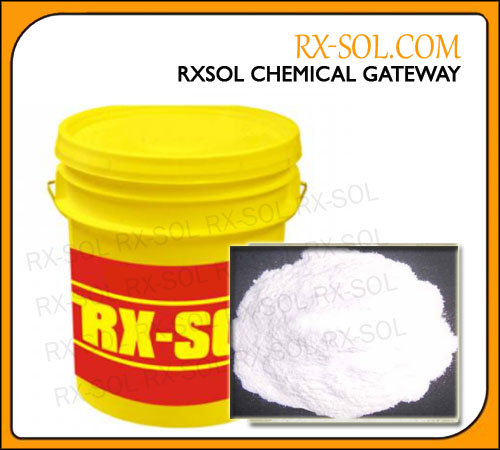
DRY ACID DESCALEX

Size:

Color:

Product Short Description: RXSOL AC-2 chemical is specialized detergent based acid with corrosion inhibitor for evaporators, boilers, heat exchangers, tanks, pipes, and other heat transfer equipment
Product Technical Specification:


Appearance

Yellowish Powder

Density

in g/cm3 at 15°C: 1.2

Flash Point

(PMCC) in °C: N/A  

pH

in 10 wt-%: 1.1

Compatibility


Metal

Avoid Aluminium, Zinc, Tin and their  alloys and Galvanised surfaces. 

Rubber

No known effect. 

Remarks:

RXSOL DESCALE POWDER is chemical compound and should be handle with all chemicals handling precaution like use chemical protective goggle, Hand gloves etc... For more details pl. refer RXSOL product MSDS. 

Images: Alt


GLUCONIC ACID

Size:

Color:

Product Short Description: Is a noncorrosive, nontoxic, mild organic acid with a brown clear appearance. It is very soluble in water and has a mild and refreshing taste. It is a good chelator at high pH, with better activity than commonly used chelators.
Product Technical Specification:
Remarks:
Images: Alt


AMERZAMINE

Size:

Color:

Product Short Description: 100 percent water soluble and 100 percent Volatile corrosion inhibitor for Low Medium High Pressure Boiler Water System.
Product Technical Specification:
Remarks:

Basic Boiler System Schematic

Below is a summary of problems associated with the common impurities in water and solutions to each problem.

List Of Problems Caused By Impurities In Water

Impurity (Chemical Formula)

Problems

Common Chemical Treatment Methods

Alkalinity (HCO3-, CO32- and CaCO3)

Carryover of feedwater into steam, produce COin steam leading to formation of carbonic acid (acid attack)

Neutralizing amines, filming amines, combination of both, and lime-soda.

Hardness (calcium and magnesium salts, CaCO3)

Primary source of scale in heat exchange equipment

Lime softening, phosphate, chelates and polymers

Iron (Fe3+ and Fe2+)

Causes boiler and water line deposits

Phosphate, chelates and polymers

Oxygen (O2)

Corrosion of water lines, boiler, return lines, heat exchanger equipments, etc. (oxygen attack)

Oxygen scavengers, filming amines and deaeration

pH

Corrosion occurs when pH drops below 8.5

pH can be lowered by addition of acids and increased by addition of alkalies

Hydrogen Sulfide (H2S)

Corrosion

Chlorination

Silica (SiO2)

Scale in boilers and cooling water systems

Lime softening

Images: Alt
Get MSDS
Get Technical Bulletin
Connect On Whats App


EDTA Solution 0.1 M , 500 ml

Size:

Color:

Product Short Description: EDTA
Product Technical Specification:

Standardized at 25°C against chemicals whose certification is traceable to NIST.
Formula: C₁₀H₁₄N₂Na₂O₈·2H₂O
MW: 372.24 g/mol
Melting Point: 255 °C
Storage Temperature: Ambient
CAS Number: 6381-92-6
EINECS: 205-358-3

Remarks:
Images: Alt
Get MSDS
Get Technical Bulletin
Connect On Whats App


EDTA Di Sodium Salt

Size:

Color:

Product Short Description: The Disodium salt of EDTA is the most commonly used form of this versatile organic complexing agent.
Product Technical Specification:

EDTA is most commonly used to determine hardness (i.e., Calcium and Magnesium ions) in water, where the pH must be approximately 10 and is usually controlled by adding a buffer such as Water Hardness Buffer. Water Hardness Indicator (Eriochrome Black T), Eriochrome Blue Black R, Calmagite, and Murexide are used for hardness or Calcium determinations using EDTA.

Remarks:

EDTA cas no : 6381-92-6
EDTA chemical Formula : 
[(HO2CCH2-)(NaO2CCH2-)N-CH2]2·2H2O

Images: Alt
Get MSDS
Get Technical Bulletin
Connect On Whats App


Zinc Chloride Anhydrous

Size:

Color:

Product Short Description: Zinc Chloride supplier and exporter.
Product Technical Specification:

Physical state and appearance

Snow White Solid.

Odor

Odorless.

Taste

Not available.

Molecular Weight

136.29 g/mole

Color

White.

Assay %

Refer below for various grade

Boiling Point

732°C (1349.6°F)

Melting Point

290°C (554°F)

Critical Temperature

Not available.

Specific Gravity

2.907 (Water = 1)

Vapor Pressure

Not applicable.

Vapor Density

4.7 (Air = 1)

Volatility

Not available.

Odor Threshold

Not available.

Water/Oil Dist. Coeff.

Not available.

Ionicity (in Water)

Not available.

Dispersion Properties

See solubility in water.

Solubility

See solubility in water.

PARTICULARS H.P. GRADE TECHNICAL COMMERCIAL SOLUTION
ASSAY (%) 98-99 90-92 80-85 APCR
APPEARANCE SNOW WHITE SNOW WHITE SNOW WHITE CLEAR SOLUTION
AMMONIA (AS NH4CL) % < 1 < 5 10-15 APCR
ALKALIES & ALKALINE EARTH (%) < 1 < 1.5 APCR APCR
IRON (PPM ) < 10 < 15 < 15 < 15
LEAD (PPM ) < 10 < 15 APCR APCR
NICKLE (PPM) < 2 < 2 APCR APCR
COPPER (PPM) < 2 < 2 APCR APCR
COBALT (PPM) < 2 < 2 APCR APCR
 
Remarks:

Use of the Zinc Chloride are Following :

Fluxes :

The property to attack metal oxide and salts from metal surface and gives good metal to metal bonding make Zinc Chloride a better raw material for fluxes.

________________________________

Dry Cell Batteries :

Zinc Chloride is used in Dry Cell Batteries as an electrolyte and also as a moisture absorbent and corrosion inhibitor.

________________________________

Glue :

It is used in manufacture of Glue, Paper, Cosmetics, Synthetic, Fibers, Disinfectants and Fire Fitting form.

________________________________

Electro Plating :

It is one of the main raw material for manufacturing of electroplating chemicals.

________________________________

Wood Preservative :

It is also a good preservative.

________________________________

Water treatment Chemicals :

It is using in water treatment because of corrosion inhibitor property.

________________________________

Catalysts :

Zinc Chloride is used as a catalyst in production of methylene chloride from methyl alcohol.

________________________________

Petroleum :

It is used to separate water from oil as it is a good emulsion breaker. It is also used in oil and gas wells.

________________________________

Rubber Vulcanization :

It is used as accelerator in the vulcanizing process of rubber.

________________________________

Anteseptic AND Deodorant Preparation :

Zinc Chloride is also used to prepare antiseptics and deodorants.

________________________________

Textile Finishing :

Zinc chloride is a more active catalyst than magnesium chloride and almost as active as zinc nitrate. It does not contribute to resin yellowing on white goods and has little effect on dye shades in tinted materials. The textile grade is used as a catalyst in resin systems that impart a durable-press or wash and wear finish to cotton and cotton synthetic blend fabrics. Zinc Chloride 50% Solution also serves as a high quality mercerizing agent for cotton.

________________________________

Raw Material & Other Chemicals :

Zinc Chloride is an excellent source of zinc and used as a raw material for the production of other zinc chemicals.

Images: Alt
Get MSDS
Get Technical Bulletin
Connect On Whats App


Sodium Acetate CH3COONa

Size:

Color:

Product Short Description: Sodium Acetate Anhydrous
Product Technical Specification:

Specifications

Extra Pure

Industrial

Sodium Acetate

CH3COONa

CH3COONa

CAS 127-09-3 127-09-3
Molecular Weight 82.03 82.03
Physical Appearance Snow White PowderWhite Off White Powder
Assay (Min.) 99% 98%
Loss on Drying (LOD) 1% Max 2% Max
pH of 5% Aqueous Solution 7.5 - 9.0 7.5 - 9.0
 
Specific Gravity   1.528 (Water = 1)
Solubility   Easily soluble in cold water, hot water.

Odor: Odorless to acetic (Slight.)
Taste: Not available.
Boiling Point: Not available.
Melting Point: 324°C (615.2°F)
Critical Temperature: Not available.
Specific Gravity: 1.528 (Water = 1)
Vapor Pressure: Not applicable.
Vapor Density: Not available.
Volatility: Not available.
Odor Threshold: Not available.
Water/Oil Dist. Coeff.: Not available.
Ionicity (in Water): Not available.
Dispersion Properties: See solubility in water.
Solubility: Easily soluble in cold water, hot water.

Remarks:
Images: Alt
Get MSDS
Get Technical Bulletin
Connect On Whats App


Heat Transfer Salt

Size:

Color:

Product Short Description: Salt inhibited with the corrosion inhibitor resulting corrosion protection, as well as efficient heat transfer.
Product Technical Specification:


Main Ingredients   : Salt Mixture with Corrosion Inhibitor
Inhibitors and
water
 
6
Inhibitors
: 6 %
Colour Bright : Yellow
Nitrite Content : 7.5 to 8.5%
Chloride Content  0.10% Max.
pH of solution : 9.5 - 10.5
Odour            : PRACTICALLY ODOURLESS
Solubility in water        : SOLUBLE
Melting Point       : Max 150 - 155 °C
Working Temp Range : 155 – 540 Deg.C
Density @ 20 Deg.C : 1160 Kg/m3
Reverse Alkalinity         : Minimm 15.0 ml
Vapour pressure    : .07 mbar at 20oC
Hear Transfer Salt TR : 155
Skin absorption/irritation       : YES
TLV       Country     :  
Pollution category    1994       : III
 
Remarks:

Why use Heat Transfer molten salts?

Heat Transfer Salt extend the upper range of the temperature limits in which a liquid heat transfer media can be used.

Images: Alt
Get MSDS
Get Technical Bulletin
Connect On Whats App


Sodium Thiosulphate Anhydrous

Size:

Color:

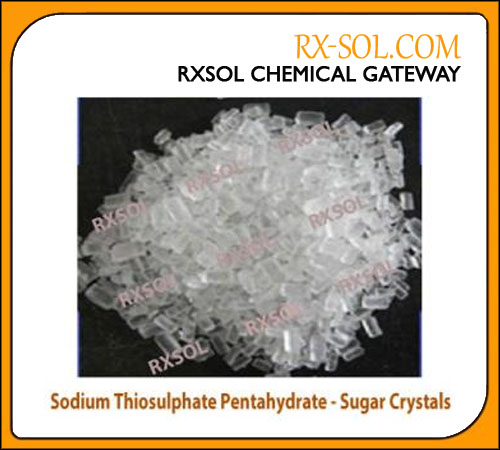
Product Short Description: Sodium Thiosulphate Anhydrous
Images: Alt
Get MSDS
Get Technical Bulletin
Connect On Whats App


Scale Remover 1507

Size:

Color:

Product Short Description: Scale dissolver. Specifically formulated to remove rust and water scale build up from boiler evaporators, heat exchangers, cooling systems, pipeline collection system etc. Highly effective on heating. Safe and easy handling and storage.
Product Technical Specification:

PRODUCT PROPERTIES of Safe Acid Descalex powder

HS CODE of Safe Acid Descalex powder 34021300

Appearance Reddish / Yellowish / white – Powder ( without indicator )  
Density 1.2g/cm3  
pH (10 wt %):1.1  
Compatibility  
Metal    Avoid aluminium, zinc, tin and their alloys. Avoid galvanised surfaces  
Rubber No known effect  
Packaging Order No.: RXSOL-54-1008-025 Size (in kg)25 , 5
Remarks:

-   Prevent run off water from entering drains if possible

Formation of Calcium Sulfate is main cause for SCALE formation :::

The principal problem potential posed by sulfate ions in water is the possibility of calcium sulfate scale formation.  Precipitation of calcium sulfate can occur when high concentrations of both calcium and sulfate exist simultaneously.  There are three primary areas of water treatment in which calcium sulfate precipitation may occur boilers, cooling systems, and ion exchangers operating in the hydrogen or acid mode.

In boilers, calcium sulfate scale formation has been reduced to a minimum by modern treatment practices.  The low hardness levels largely preclude calcium sulfate boiler scale.    By contrast, cooling systems are subject to calcium sulfate scale deposition because the makeup is usually not treated for hardness removal.  Cooling water is usually treated with sulfuric acid for pH control, and the makeup is cycled, i.e. concentrated.  Calcium sulfate scale deposition can  result unless the cycles of concentration are properly controlled in conjunction with the proper use of scale control chemicals.  Cation ion exchangers regenerated with sulfuric acid also can pose a major calcium sulfate problem. Calcium sulfate precipitation can be avoided by controlling the acid concentration and the flow rate through the exchanger.  

Sulfate content can be calculated in Laboratory by using this method ::: http://rxmarine.com/SULFATE-TEST-KIT

Images: Alt